

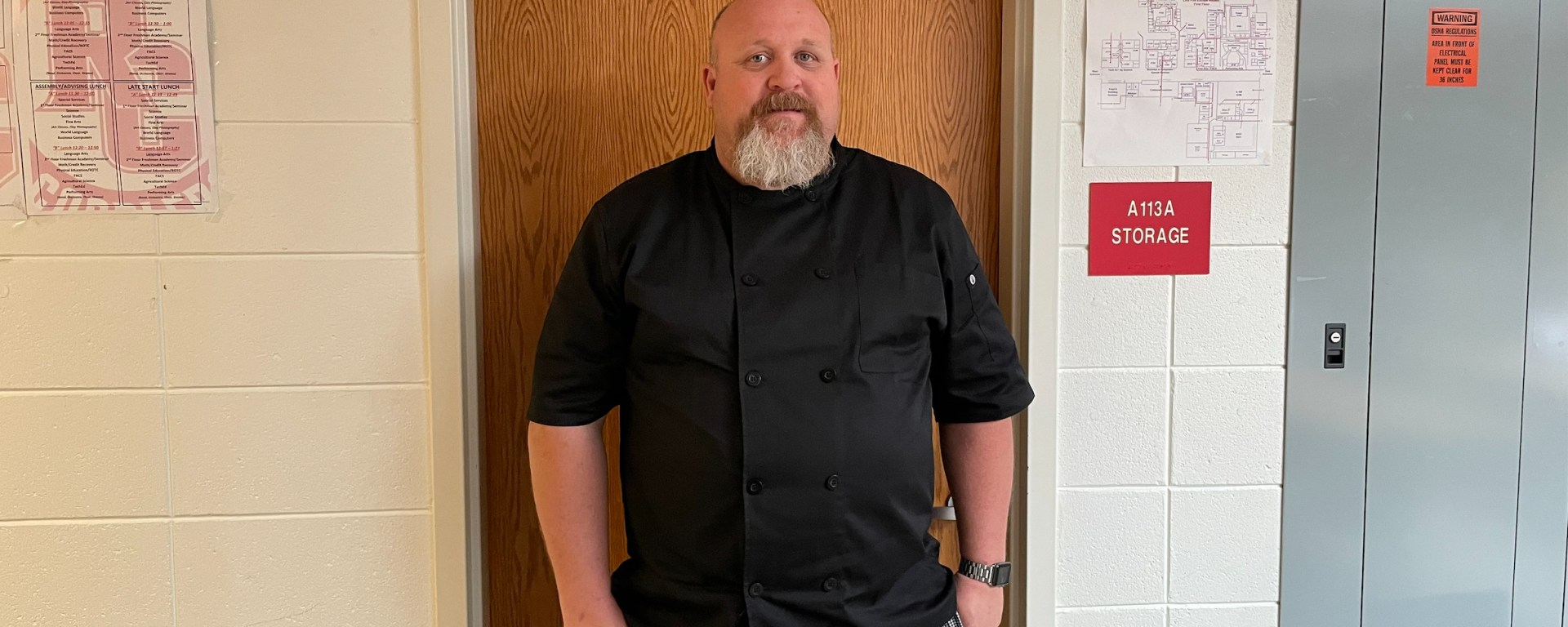
Mr. Hagen stepped aside from English teaching to revive Central High School’s culinary arts program.
Michael Hagen teaches cooking all day at school, and then goes home and cooks dinner for his family as well–but he never gets tired of it.
“I just love to be in the kitchen,” he says.
Mr. Hagen taught English at Central for 13 years, most recently in the Freshman Academy, but this year he switched to teaching Culinary Arts. In addition to being Hagen’s first year with the class, it is the first year in a while that there has been a cooking class at all. A Culinary Arts class was in the schedule for last year, but the teacher quit just before the school year started, so the class wasn’t held.
Mr. Hagen teaches two cooking classes, Intro to Culinary Arts and Culinary Arts 2. The Intro class focuses more on the bookwork side, while Culinary Arts 2 focuses more on cooking and making more complex recipes. It is a much smaller group than Hagen’s Intro to Culinary Arts classes, as most students who took the Intro didn’t have space in their schedule to fit another class in during the second semester.
Generally, classroom time is split between classroom learning and cooking labs, with two or three days a week on each. Classroom learning consists of lessons specifically related to the restaurant industry. Students learn how restaurants work and how to run them, learning everything from how to calculate cost of goods to how to be a manager.
Cooking labs are just that–cooking. In Intro to Culinary Arts, students make donuts, garlic parmesan french fries, chicken tenders, stir fry, chocolate chip cookies, and more. According to Hagen, students are shocked that they can make the donuts and chicken tenders. Chocolate chip cookies are also a favorite; Hagen’s favorite cooking lab is the chinese unit, where students make cream cheese wontons and egg rolls. Second semester students make tacos (including the tortillas and taco meat), ravioli, steak, and Chinese dumplings, among other things. Hagen gets to pick what the cooking labs are, as opposed to the classroom learning, which he has a curriculum for. He tries to have a general overview of skills in the cooking labs–learning how to bake, fry, use knives, etc. He tends to do more baking than cooking with students because of budget reasons.
95% of students come into the class with zero experience in the kitchen. Most of them haven’t cooked at home, and are too young to have worked in a restaurant–most places require employees to be 18 before working in a kitchen. Hagen said that that was “a shock to me at first.” There were a lot of skills he assumed the students knew that they didn’t, meaning he had to go way back to the basics–things like what a ladle was, and how to turn on an oven.
As for the food, the students eat what they make. According to Hagen, there is enough for them to eat, not just sample. Sometimes students will take extras with them and share with their friends in other classes.
Hagen says that his favorite part of teaching the class is getting to share his experiences with kids. He worked in the restaurant industry before becoming a teacher and has “a lot to offer” in terms of experience and knowledge, and enjoys being able to share that with kids.
On the other hand, the hardest part of teaching the class is the new period schedule. The shortened class periods mean that for cooking labs, students have to prep, cook, and clean up in fifty minutes. Because of that, a lot of the baking labs end up being split between two days in order to have time.
Hagen’s long-term goal is to be able to run the class as a restaurant, where other Central students could come and buy the food that the class is making. Hagen sees it as valuable real-world experience for his students, to have to take a lunch order, make it, and give it back to a person. Even as the class is now, taking it could give students a leg up when trying to find a job after high school. If they were to apply to a restaurant, having basic cooking skills could get them hired over someone else who doesn’t have those skills.
Hagen’s favorite food is barbeque, and he has owned his own barbeque company for several years. Chinese and Mexican food tie for second.
Header Photo by Airelyn Trimmer
 The Pine Needle