

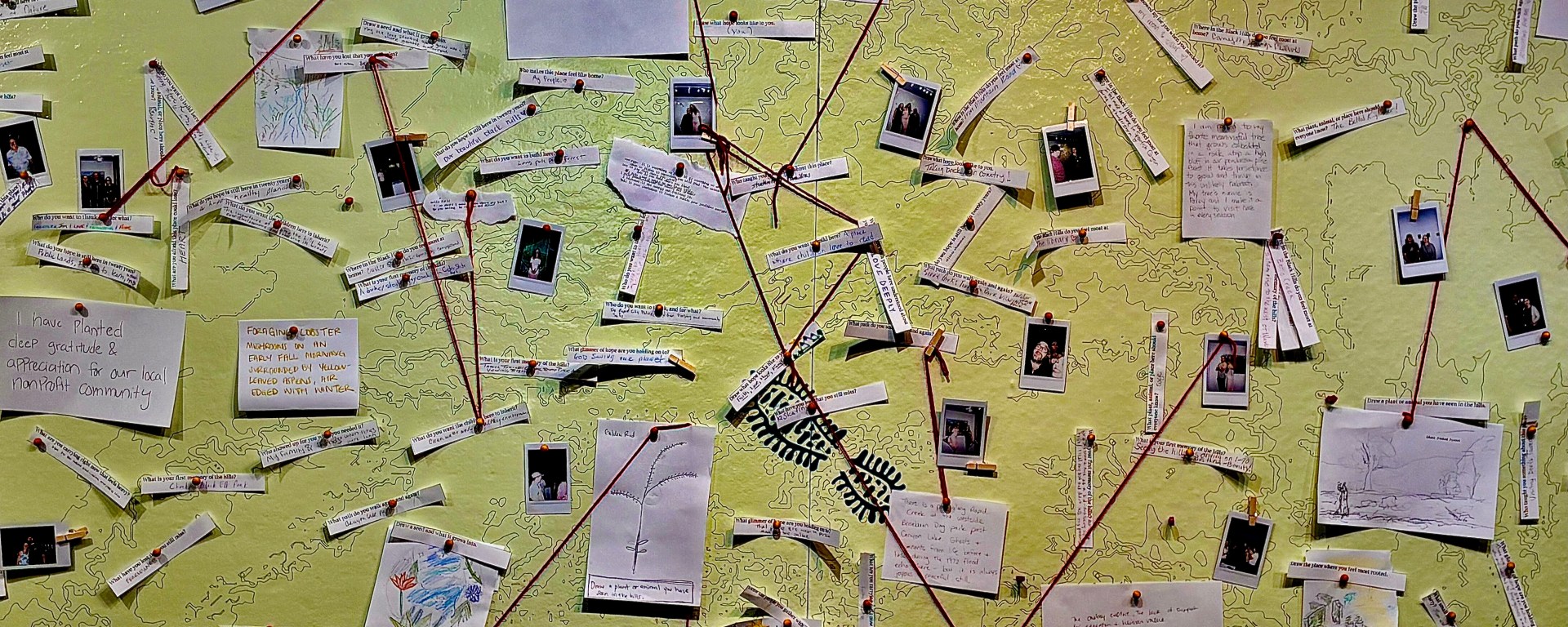
Cobbler art teacher Sophia Clarke discussed with the Pine Needle her exhibit, “Living Map: What Grows When We Gather.”
By Aiden Jensen and Isabella Cuny
The Dahl Arts Center has opened an interactive art exhibit with help from a Central High art teacher. Sophia Clarke has worked at Central for four years, teaching a variety of art classes. Over the summer Ms. Clarke applied for a grant presented by the Dahl to create an interactive exhibit. It opened October 9th and it will stay up for eleven weeks.
“I found out that very little people applied so they extended the deadline,” says Ms. Clarke, “I hyperfixated on it for eleven days over the summer. I would wake up and I would work on the proposal and then go to sleep and then wake up work on the proposal and go to sleep. I would take naps in the middle of the day—very chaotic vibes.”
Once her proposal was ready it was presented to the board at the Dahl Arts Center, and it was time to begin putting the gallery together. “People think, when they hear a name, that person did everything and sometimes they do, but along the way you have people who definitely up lift you, and I don’t think I could have gotten a quarter of it done without some help.”
Everyone who helped Ms. Clarke with her venture were artists, many of them also teachers at Central. “She couldn’t have done any of this without me,” joked Luke Gorder, who helped with some wood working.
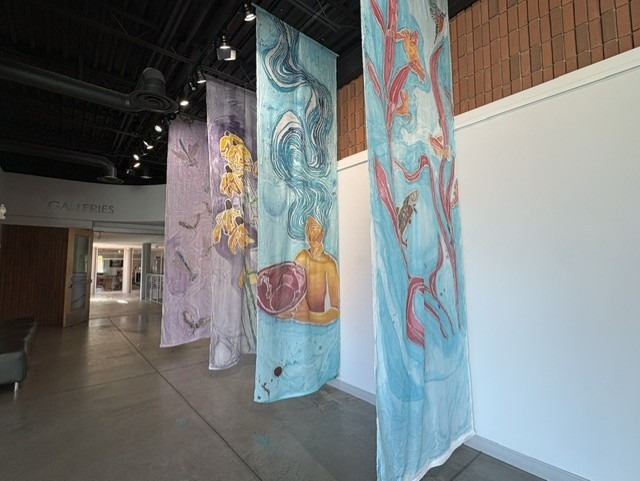
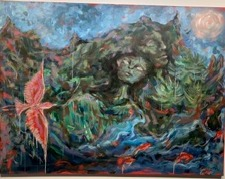
The gallery consists of two parts. First is the visual portion of the gallery: eight silk tapestries depicting plants and animals native to the Black Hills and scenes of nature represented by humans. “My theme was really the Black Hills as an environment,” says Ms. Clarke. “I went the route of viewing the community like an ecosystem so it’s a bunch of native plants. One of them is Black Elk Peak literally depicted as a black elk as the highest point of the Black Hills. And then a white clover which is the smallest thing in the hills. I wanted to show it from its largest point to its smallest point.” On the wall besides the tapestries is a canvas painting rendering the entire Black Hills as mother nature.
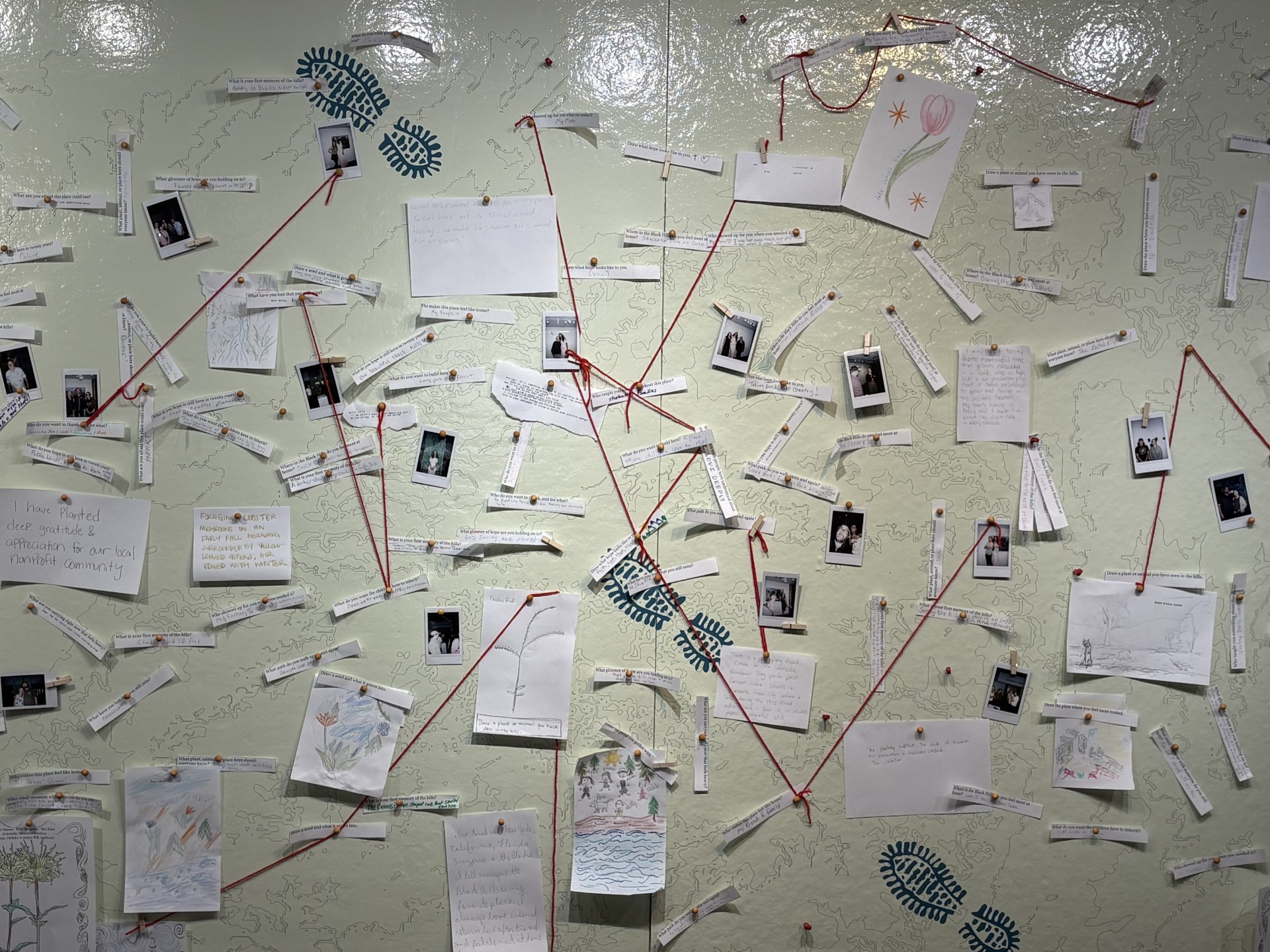
As you move to the back of the exhibit you enter the interactive portion. A topographic map of the Black Hills hangs on the back wall so people can pin things on it, whether a message written on a supplied typewriter or a drawing. There are questions supplied, like, “What has planted hope inside you?” and “What type of impact do you hope to leave?” There are drawings by people of all ages, drawings of flowers, friends, and animals. Among them there is a sea of small papers where people have written messages. Some are very descriptive, explaining exact parts of the Hills that mean a lot to people. Others simply say a special person’s name, or a date.
“I had to ask so many people for help,” says Ms. Clarke while reflecting on her work. “I learned so many things that they had knowledge in and that was helpful because then it added weight or frame of reference to a fraction to something that I knew. You can know a piece of the puzzle and then someone else will add to your puzzle and then your knowledge grows and that’s great and that research bone grows and you don’t really have to know what you’re doing at the beginning, but then that curiosity helps build what you do know. Just experiment do things outside of your comfort zone its good for you.”

